Teaching children bicycle safety: helmets, skills and routes
Safe riding is learned in stages. Fit the helmet properly, build skills away from traffic, teach the rules, then practice real routes together before a child rides alone.
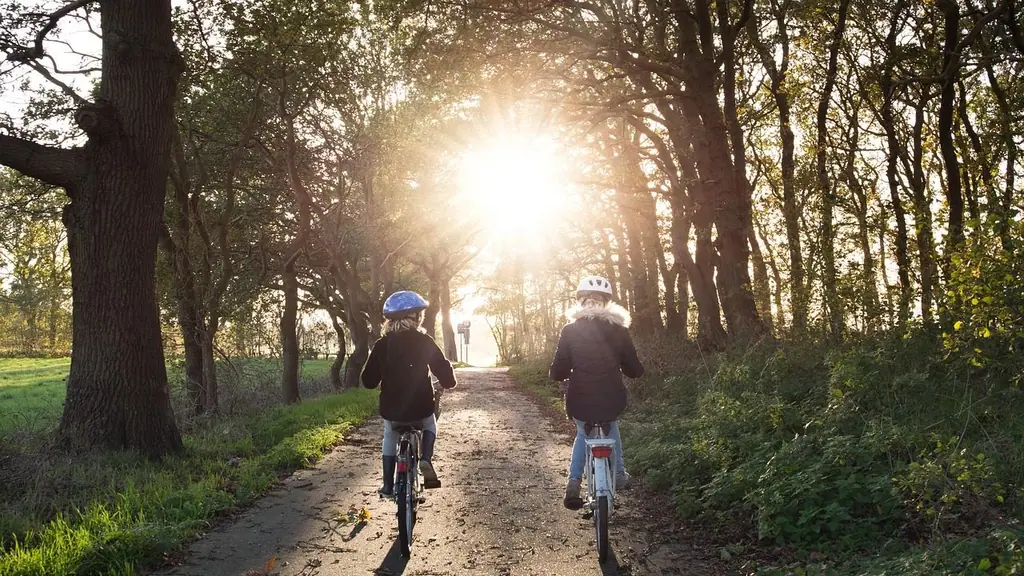
Children do not become safe cyclists in one afternoon. Balance comes first, then control, then the judgment needed to share space with other people. Parents can help most by teaching those stages in order and by riding alongside until a child has shown, on real routes, that they are ready for more.
This guide covers four parts of that process: helmet fit, a skills progression, the rules of the road, and route practice.
Start with a helmet that fits
A helmet only protects well when it fits and is worn correctly. The CDC’s bike helmet fact sheet gives a practical fit check that parents can do in a minute:
- Snug all around. The helmet should sit snugly with no gaps between the foam and the head, but not so tight that it causes headaches.
- Level and low. The bottom of the front pad should be one or two finger widths above the eyebrows.
- Side straps. The straps should form a V shape under, and slightly in front of, each ear.
- Chin strap. It should be centered under the chin and snug, with no more than one or two fingers fitting between strap and chin.
- Yawn test. Ask your child to open their mouth wide. The helmet should pull down on the head; if it does not, tighten the chin strap.
- No movement. Once buckled, the helmet should not shift back to front or side to side.
NHTSA’s bicycle safety pages note that sizing varies between manufacturers and that a good fit can take time, so it helps to use a mirror or have another adult check. The CDC also advises re-checking fit when a child’s hairstyle changes.
Look for a label showing that the helmet meets the U.S. Consumer Product Safety Commission standard. According to the CPSC’s helmet guide, all bicycle helmets made after 1999 must meet the federal standard at 16 CFR part 1203. The CPSC also cautions against adding stickers or attachments that did not come with the helmet.
Florida’s helmet law for riders under 16
In Florida, a helmet is not optional for children. Florida Statute 316.2065, as published in the 2026 Florida Statutes, requires any bicycle rider or passenger under 16 to wear a helmet that is properly fitted, fastened securely and compliant with the federal standard at 16 CFR part 1203. Officers may issue a warning or a citation, and a first violation is dismissed if the rider shows proof of buying a compliant helmet.
Helmet rules differ from state to state, so check the law wherever you ride. Whatever the legal minimum, the AAP’s guidance is that children should wear a helmet on every ride, including short ones near home.
A skills progression
NHTSA recommends that new riders build skills somewhere safe and away from traffic, such as a park, a path or an empty parking lot. Move to the next stage only when your child can do the current one consistently, without wobbling or needing reminders.
| Stage | Skills to practice | Ready to move on when the child can… |
|---|---|---|
| 1. Control | Starting, gliding, steering in a straight line, stopping with the brakes | Stop smoothly on request and ride a straight line |
| 2. Awareness | Looking ahead for hazards such as potholes, grates, gravel and toys | Steer around obstacles without sudden swerves |
| 3. Communication | Looking back over the shoulder; one-handed hand signals | Signal and look back while holding a steady line |
| 4. Shared paths | Riding on paths with a parent; passing people with a bell or a spoken warning | Keep right, pass courteously and slow down near people walking |
| 5. Quiet streets | Riding with traffic, stopping at stop signs, watching driveways | Follow the rules reliably with a parent alongside or just behind |
The third stage is a useful checkpoint. The American Academy of Pediatrics’ bicycle safety myths and facts page says children should learn hand signals before riding in the street, and that a child who cannot signal without falling or swerving should not ride in the street.
Before every session, run through a quick check of tires, brakes and the helmet. Our interactive pre-ride safety checklist and the guide to the pre-ride bicycle safety check make that routine easy.
Teaching the rules of the road
The AAP lists four core rules for children: wear a helmet, ride on the right side with traffic, use hand signals, and obey traffic signals and stop signs. NHTSA adds a few habits that are worth teaching explicitly:
- Ride predictably. Go in the same direction as traffic, in a straight line, where drivers expect to see you.
- Assume drivers may not see you. Make eye contact where possible and be ready to stop.
- Watch driveways. Slow down and look for cars backing out or turning.
- Cross carefully. When crossing from a sidewalk, slow down, look left, right, left and behind, and follow pedestrian signals.
- No distractions. No phones or headphones while riding.
Timing matters too. The AAP says children should not ride at dusk or after dark, and that reflective clothing and reflectors do not make night riding safe for them.
Sidewalks
Sidewalk riding rules vary by state and city. In Florida, as of the 2026 statutes, a person riding a bicycle on a sidewalk has the rights and duties of a pedestrian, must yield to people walking and must give an audible signal before passing them. NHTSA notes that drivers pulling out of driveways often do not expect fast-moving traffic on a sidewalk, so children who ride there should slow down at every driveway and intersection, and ride in the same direction as traffic. Check local ordinances too, which may add rules of their own.
Practicing real routes
Once your child is comfortable on quiet streets, practice the routes they will actually use, such as the trip to school, a friend’s house or the park.
- Choose the route together. NHTSA suggests favoring routes with less traffic and slower speeds, or using paths and bike lanes where available.
- Walk it first. Walking the route at a slow pace makes it easier to point out driveways, crossings and blind corners.
- Ride it together, many times. Start with you in front, then ride behind so your child leads and makes the decisions while you observe.
- Talk through choices. Ask your child where they would stop, look or signal, and why.
- Add independence gradually. A common next step is following at a distance, then riding with a trusted friend, before riding alone.
Community programs can help. Safe Routes to School programs organize education, group rides and route improvements around schools. The Federal Highway Administration’s Bicycle Safer Journey offers short videos with quizzes and discussion material for ages 5 to 9, 10 to 14 and 15 to 18, suitable for use at home or in a classroom.
Model the behavior you want to see
Children copy adults. Wear your own helmet, stop fully at stop signs, signal every turn and explain what you are doing as you ride. If the family bike needs attention, fix it before riding, and make sure your child’s bike still fits as they grow; our guide to choosing a bicycle for children explains what to check.
Key takeaways
- Fit the helmet using the finger, V-strap and yawn checks, and replace it after any crash.
- Florida requires riders and passengers under 16 to wear a properly fitted helmet that meets the federal standard (Florida Statute 316.2065, 2026).
- Teach skills in stages, starting away from traffic, and use hand signaling as a readiness test for street riding.
- Teach the core rules: ride with traffic, signal, obey signs and signals, and do not ride at dusk or after dark.
- Practice real routes together repeatedly before a child rides them alone.
Questions readers ask
What happens if a child in Florida rides without a helmet?
Under Florida Statute 316.2065 (2026), a violation is a noncriminal traffic infraction treated as a pedestrian violation, and an officer may give a warning or a citation. For a first violation, the court must dismiss the charge if the rider shows proof of buying a compliant helmet. Check current law, as statutes change.
Does a helmet need replacing after a minor fall?
If the helmet hit the ground or was involved in a crash, yes. The CPSC explains that bicycle helmets are designed for a single impact and that the foam may be crushed even when no damage is visible.
Can a child wear their bike helmet at the playground?
No. The CPSC warns that children should not wear helmets on playgrounds or while climbing trees, because the chin strap can catch on equipment and create a strangulation risk.
Sources
- Get a Heads Up on Bike Helmet Safety, CDC (2018).
- Which Helmet for Which Activity? (Publication 349), U.S. Consumer Product Safety Commission (2026).
- Bicycle Safety, NHTSA (2026).
- Florida Statutes 316.2065, Bicycle regulations, Florida Legislature (2026).
- Bicycle Safety for Children: Myths & Facts, American Academy of Pediatrics (HealthyChildren.org) (2026).
- Bicycle Safer Journey, Pedestrian and Bicycle Information Center / FHWA (2026).
Green Mobility Network is an independent publication. This article is for general information and is not legal, medical or professional advice; rules differ by state and city. Spotted an error? Read our corrections policy and write to contact@greenmobilitynetwork.org.