Green bike lanes explained, and Miami Beach's 16th Street lane
Green pavement went from experiment to national standard in about a dozen years. Here is what the rules allow, what the evidence says, and how Miami Beach began using it in 2016.

Historical note: This address was previously part of the website of Green Mobility Network, a Miami-area advocacy group that posted news there about Miami Beach’s 16th Street bike lane in 2016. This site is now an independent publication and is not affiliated with that group. You can view the archived original via the Internet Archive. The explainer below is new and does not reuse the old post’s text or images.
In January 2016 the City of Miami Beach repainted the bike lane on 16th Street green, one of the first green lanes in the city. The archived news post at this address celebrated the change. Ten years on, green bike lanes are common across the country and are written into the national traffic-control manual. This page explains why lanes are painted green, how the rules evolved, what the research shows, and what has happened in Miami Beach.
Why paint a bike lane green?
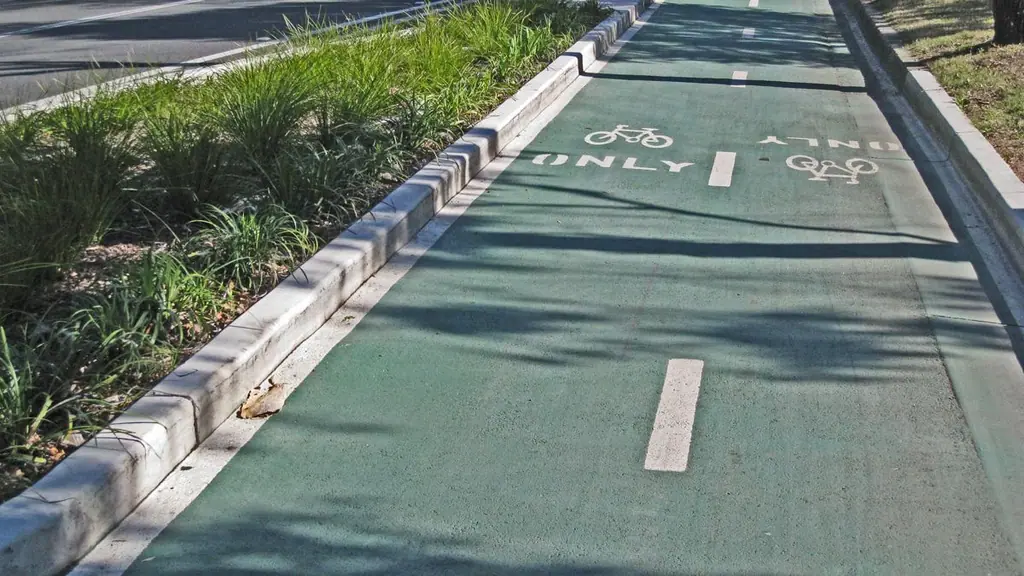
Green pavement is a visibility tool. The current federal manual describes it as a way to make it more obvious where bicyclists are expected to ride, and where bicyclists and other traffic may cross or weave across each other’s paths. Typical locations include the approach to an intersection, a stretch where right-turning cars must merge across a bike lane, or a driveway-heavy corridor.
Color does not replace the basic markings. A green bike lane still needs its white lane lines and bicycle symbols; the color is a supplement that draws attention to them.
From experiment to national standard
In the United States, traffic signs and markings are governed by the Manual on Uniform Traffic Control Devices (MUTCD), published by the Federal Highway Administration.
2011: interim approval. On April 15, 2011, FHWA issued Interim Approval IA-14, allowing optional use of green colored pavement in marked bike lanes and their extensions through intersections and other conflict areas. Agencies had to request permission, follow technical conditions including a specified shade of green, and keep an inventory of locations. FHWA stressed that the approval did not require anyone to use green paint.
2023: written into the manual. FHWA published the 11th edition of the MUTCD in December 2023, and FHWA notes that a Revision 1 dated December 2025 is now the current version. Section 3H.06 of Part 3 covers green-colored pavement for bicycle facilities. In summary, it:
- limits green pavement to bike lanes, bike lane extensions through intersections, weaving areas where drivers cross a bike lane to reach a turn lane, two-stage bicycle turn boxes, bike boxes, and backgrounds for bicycle detector symbols;
- prohibits green in crosswalks, in electric-vehicle parking areas, behind shared-lane markings, and as a substitute for required bike markings;
- requires the green pattern to match dotted extension lines when used through conflict areas;
- allows green for the full length of a bike lane or only for selected portions.
States and cities apply these rules through their own design standards, so details can vary. Check FDOT and local guidance for specific projects.
What the research shows
Evidence on green pavement is generally positive but limited. A 2008 evaluation of a green bike lane weaving area in St. Petersburg, Florida, conducted by the UNC Highway Safety Research Center with FDOT, found that after the green treatment and signs were added, motorists yielded to bicyclists significantly more often, more drivers signaled their turns, and more bicyclists scanned for traffic. Conflicts declined, though not by a statistically significant amount.
Color is not a substitute for physical protection. Paint does not stop a car, and green surfaces need maintenance to stay visible and skid-resistant. That is why many cities use green at conflict points while building separated or protected lanes for the main corridor. Our explainer on the benefits of protected bike lanes covers that side of the debate.
Miami Beach and beyond
Miami Beach’s 16th Street lane, which the city lists as running between West Avenue and Collins Avenue, became one entry in a growing list. The city’s Pedestrians and Bicycles page says its transportation department has pursued green bike lanes as part of an expanding network and reports seven completed projects totaling 31,000 linear feet of lanes on both sides of the road. Corridors it lists include parts of the Venetian Causeway, Alton Road and Ocean Drive. The city also notes that in 2015 its commission adopted a mode-share hierarchy that puts pedestrians first, followed by transit, bicycles and freight, with private vehicles last.
Elsewhere in Miami-Dade, green paint has become a standard part of safety packages. When the county responded to cyclist deaths on the Rickenbacker Causeway in 2022, the mayor’s memo described adding warning signs to supplement the causeway’s continuous green-painted bike lanes, alongside delineators and other measures.
For more on designing better networks, see how cities can improve cycling infrastructure and our cycling infrastructure hub.
Where to find official information
- FHWA MUTCD website: the current edition, revisions and official interpretations.
- FDOT: Florida’s adoption of the MUTCD and state design standards.
- City of Miami Beach Transportation and Mobility: local bike lane projects and maps.
- Miami-Dade Department of Transportation and Public Works: county road projects.
Key takeaways
- Green pavement highlights bike lanes and conflict areas; it supplements, and never replaces, standard bike markings.
- FHWA allowed it under Interim Approval IA-14 in 2011, and the MUTCD 11th edition (December 2023) now covers it in Section 3H.06.
- A 2008 Florida study found more driver yielding and signaling after green treatment at a weaving area.
- Miami Beach painted 16th Street green in 2016 and now lists multiple green-lane corridors.
Questions readers ask
Do drivers have to stay out of a green bike lane?
The color itself does not create a new rule; the lane markings and state traffic law do. Green paint highlights where bicyclists ride and where drivers may need to yield or cross. Follow posted signs and markings, and check your state's current law.
Can green paint be used in crosswalks?
No. The MUTCD 11th edition specifically says green-colored pavement shall not be incorporated into crosswalks or used behind shared-lane markings.
Sources
- Interim Approval for Optional Use of Green Colored Pavement for Bike Lanes (IA-14), FHWA (2011).
- MUTCD 11th Edition, FHWA (2023).
- Manual on Uniform Traffic Control Devices, 11th Edition, Part 3: Markings, FHWA (2023).
- Evaluation of a Green Bike Lane Weaving Area in St. Petersburg, Florida, Pedestrian and Bicycle Information Center (UNC Highway Safety Research Center) (2008).
- Pedestrians and Bicycles, City of Miami Beach.
- Implementation of Immediate Additional Cyclist Safety Measures along Rickenbacker Causeway, Office of the Mayor, Miami-Dade County (2022).
Green Mobility Network is an independent publication. This article is for general information and is not legal, medical or professional advice; rules differ by state and city. Spotted an error? Read our corrections policy and write to contact@greenmobilitynetwork.org.